

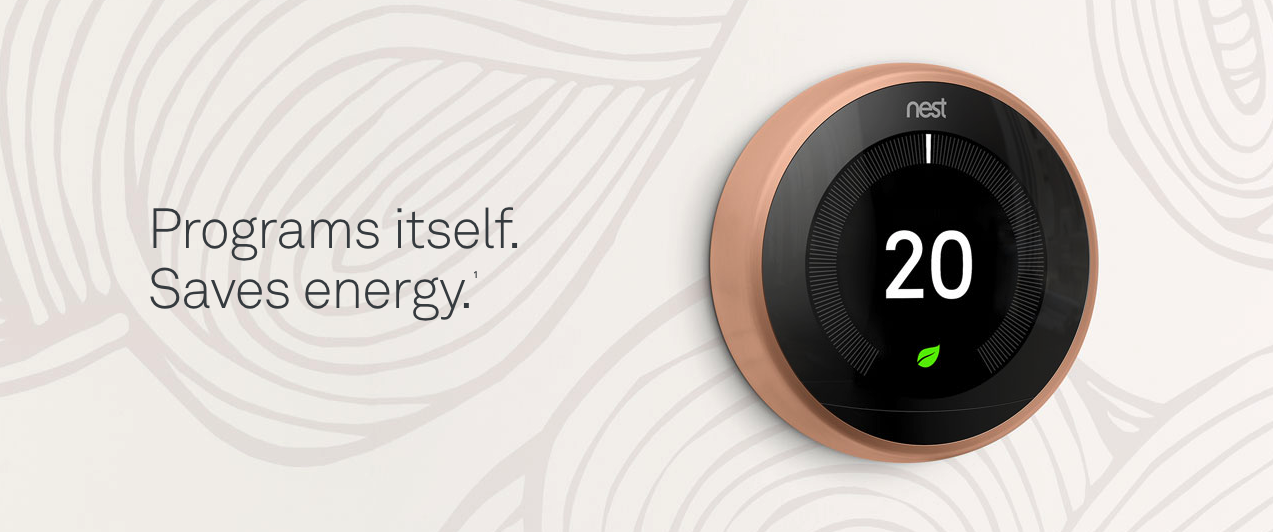
This page is about the 3rd generation Nest Learning Thermostat and its Heat Link, which is still the kit most UK houses with “a Nest” actually have. Google’s current Nest Learning Thermostat (the later generation sold in some markets) and the cheaper Nest Thermostat are different products. Google’s own help still lists OpenTherm on the 3rd gen Learning Thermostat and the Nest Thermostat E — not on every Nest display. Check the model on the wall and Google’s compatibility notes before you assume OpenTherm.
Do not wire the Nest display into the boiler. High voltage will destroy it. Google’s UK install guide says to fit the Heat Link first, and that a 3rd gen Heat Link on a heating system should be installed by a professional. 230 V work is not a homeowner job. If the connections are on the boiler itself, that is also Gas Safe territory.
The hub “Nest Learning Thermostat” compatibility article it linked is not on this site. Use Google’s checker and the Heat Link install guide, and treat the diagrams below as a reading aid for an engineer — not a DIY method.
How a combi is usually switched
Almost every combi has a pair of contacts that start the heating. They are not all the same voltage:
- 230 V switched live — the common UK setup. A live arriving on the boiler’s switched-live terminal is a call for heat. Often a live-supply and switched-live pair.
- Volt-free / zero-volt — a dry pair. The boiler supplies its own extra-low voltage across those terminals.
- 24 V — uncommon on UK domestic combis; treat it as low voltage, not mains.
- OpenTherm — a two-wire digital bus. The thermostat can ask for a flow temperature, not just on or off. See OpenTherm boilers and controls.
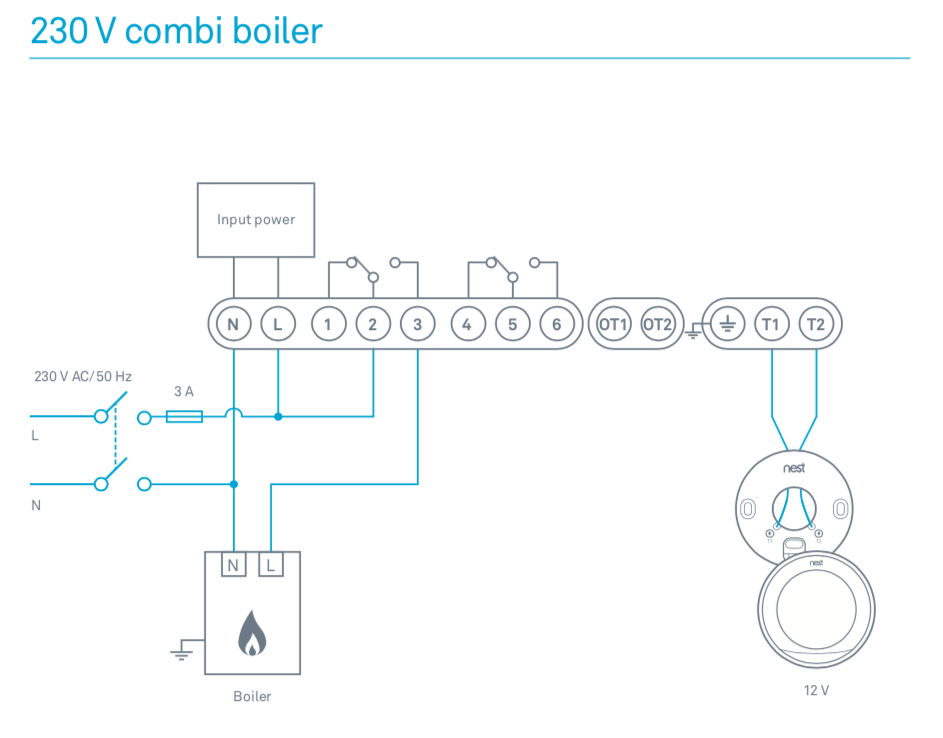
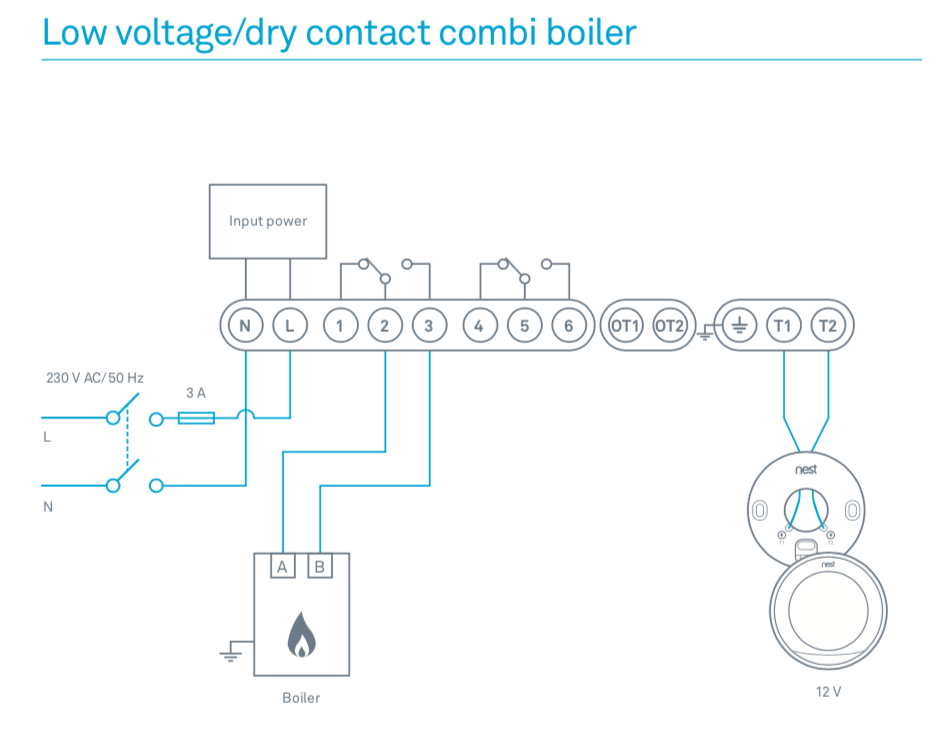
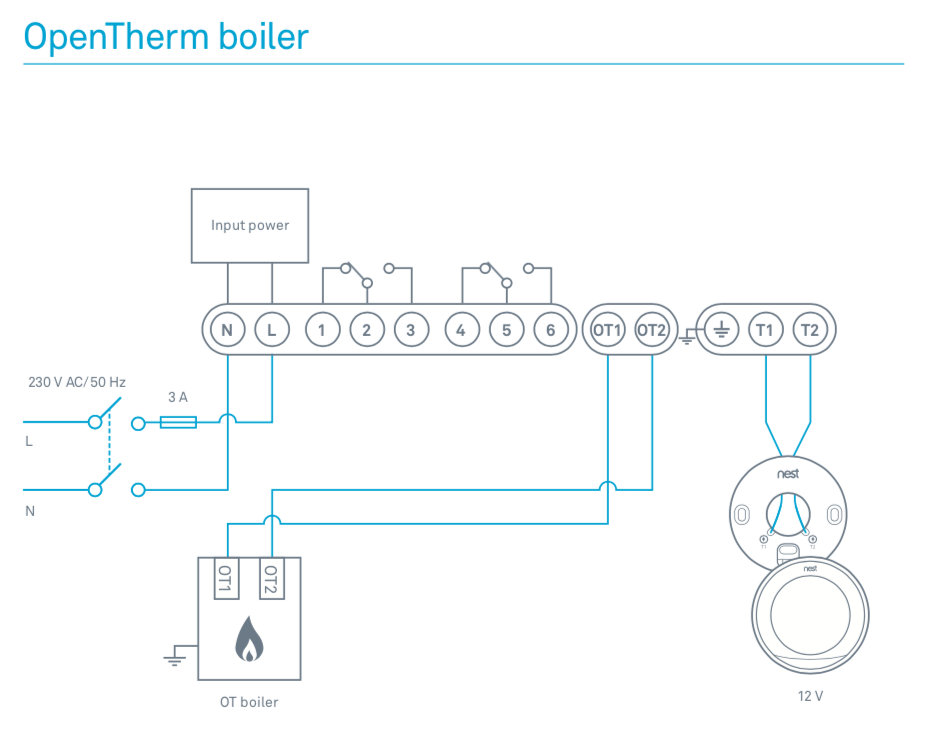
The Heat Link heating relay is terminals 2 (common) and 3 (normally open / call for heat). Terminal 1 is normally closed. OpenTherm is OT1 and OT2. L and N power the Heat Link at 230 V. T1 and T2 are the 12 V feed to the Nest on the wall if you use the wired link.
230 V combi
Live is landed on Heat Link terminal 2 — either jumped from the Heat Link’s own L, or taken from the boiler’s live-supply terminal. Terminal 3 goes to the boiler’s switched-live (call-for-heat) terminal. That is the on/off switch. It is still 230 V.
Volt-free or 24 V combi
The extra-low-voltage pair goes to terminals 2 and 3. Terminal 2 is usually the common or feed-in, terminal 3 the feed-out. Do not put 230 V onto a volt-free interface. That is how a PCB dies, and how a “Nest install” becomes a boiler repair.
OpenTherm
OpenTherm is a two-way bus, not a switch. The boiler’s OpenTherm pair lands on OT1 and OT2. The heating relay on 2 and 3 is then unused for that call-for-heat. You still power the Heat Link on L and N.
Only do this if the boiler’s own documentation shows an OpenTherm interface — or a manufacturer-approved OpenTherm module. Vaillant eBUS is not OpenTherm. Worcester’s older OpenTherm path is model-specific. The hub “OpenTherm Capable Boiler” and “Modulating Controls” links now live on this site as OpenTherm boilers and controls and modulating boilers and smart controls.
Getting more from the pairing
On/off Nest on a combi that can modulate is a missed trick. OpenTherm, or the boiler’s own weather compensation, is what drops the flow temperature. Balancing the radiators still matters: an upstairs bedroom that never quite reaches setpoint makes True Radiant keep the whole house on.
True Radiant (3rd gen) starts the heating early so the room is at the setpoint at the time you asked for. Radiator systems often warm in well under an hour. Capping True Radiant at about an hour stops the house coming on at four in the morning for a seven o’clock setpoint. Underfloor heating is slower — see Nest underfloor heating.
A lower heating flow temperature, set on the boiler or through OpenTherm, gives the house a longer, quieter warm-up. The Nest then sees a steadier room temperature instead of a blast of 75 °C water and a short cycle. That is the same advice as reducing the flow temperature on a condensing combi, not a Nest-only trick. Use the boiler optimiser if you want a starting flow and a maximum heating output.
Related
- Smart thermostats
- OpenTherm boilers and controls
- Combi boiler
- Nest underfloor heating
- Hive 2 standalone mode — a different thermostat, same “how is this wired” question
Guidance only. 230 V Heat Link wiring and any connection on the boiler must be done by a competent person. Gas work in the UK needs a Gas Safe registered engineer. Confirm terminals against the boiler and Nest install guides for the exact models on site.