

A combination boiler heats central heating water and domestic hot water in the same case. There is usually no hot-water cylinder and no loft tank. Water for the taps is heated on demand from the mains. That is why a combi is the usual choice in flats and smaller houses: it frees the airing cupboard.
It is still a gas appliance. A Gas Safe registered engineer must install it, notify Building Regulations (often through a competent-person scheme such as Gas Safe or OFTEC’s partner schemes), commission it, and leave Benchmark paperwork. Reading this page is not a substitute for that.
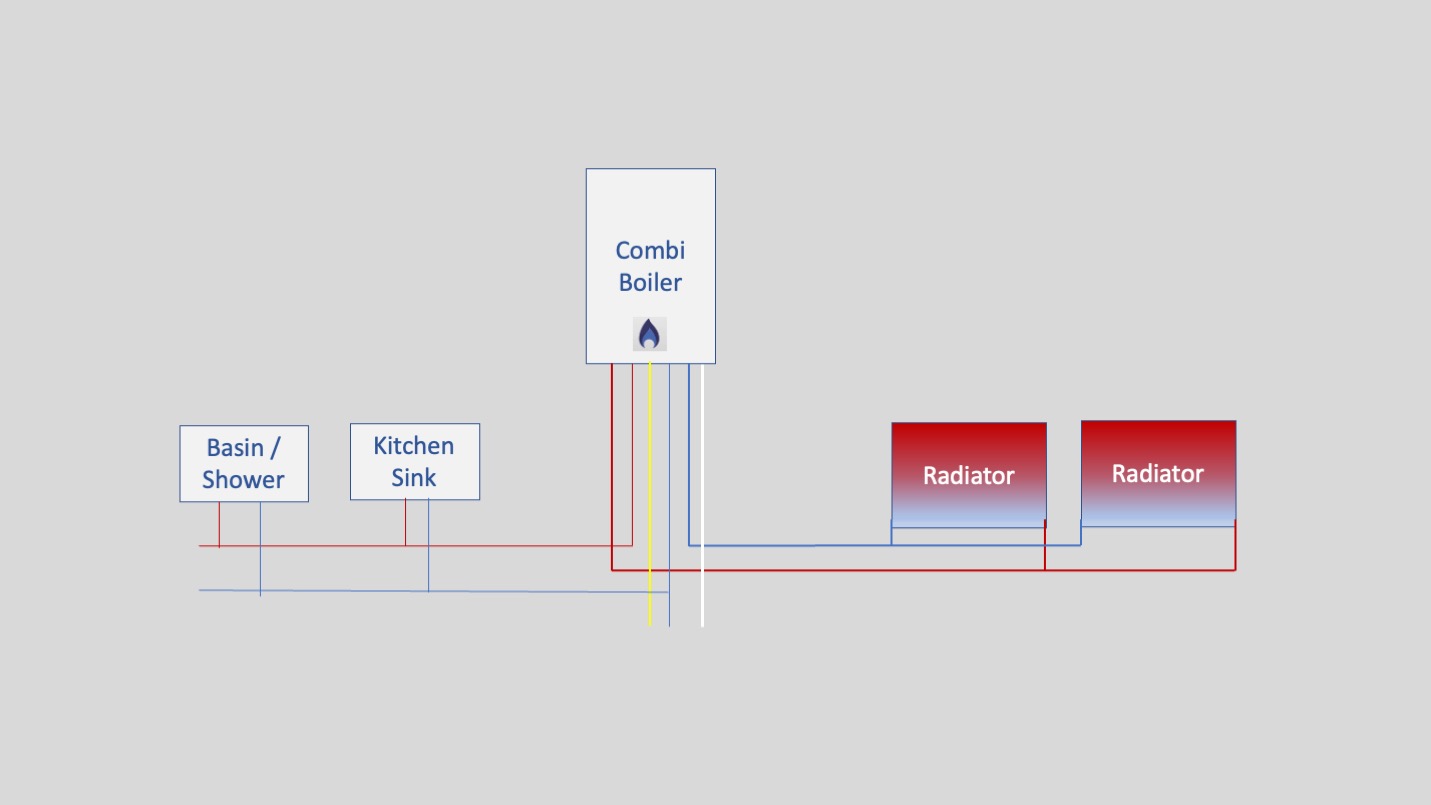
What a combi actually gives you
- Space. No cylinder, no F&E tank. That is the real advantage in a small property.
- Hot water on demand — not instant at the tap. The boiler starts when a tap opens. You still wait for the pipe to the tap to run hot. Two showers at once share the same flow; a high DHW kW rating and decent mains pressure decide whether that works.
- No stored backup. If the boiler stops, heating and hot water both stop. An electric shower is the usual fallback. There is no immersion heater.
- Efficiency is not automatic. New gas boilers in the UK are condensing and ErP A-rated for heating. A combi only condenses well if the return water is cool enough. Leaving the flow at a factory 75 °C throws most of that away — see lowering the flow temperature.
The hub claim that a combi “reduces your carbon footprint” is only true against an older non-condensing boiler, or against a badly insulated cylinder that dumps heat into a cupboard. Against a modern system boiler and a well-insulated cylinder, the carbon difference is small. The choice is usually space, simultaneous hot-water demand, and the state of the existing pipework.
The hub also said the install “may be higher than traditional systems” but pays back. A like-for-like combi swap is often the cheaper day. Converting from a regular or system boiler — cylinder out, pipes altered — costs more. Current fitted bands are on combi boiler cost.
When a combi is the wrong appliance
- Weak incoming mains. Combis need usable mains pressure and flow. A 15 mm incoming main, a long shared supply, or a loft-tank house with poor incoming pressure can leave a shower weak. Check the incoming flow before you buy the boiler. See low mains water pressure.
- Two bathrooms in regular use at the same time, unless you specify a high-output or storage combi and the incoming main can support it.
- A house that already has a sound cylinder and you want an immersion as backup, or you may want a heat pump later — stored hot water is then the simpler path.
Size the hot-water side on flow rate at a stated temperature rise, not on the badge kilowatt number alone. What size boiler walks through that. Large homes can still take a combi; the specification has to be done, not assumed.
What the installer has to get right
Gas, flue, and condensate
Natural gas or LPG, with a supply that can meet the new boiler’s maximum rate. A flue that meets the manufacturer’s instructions and Approved Document J: clearances from windows, boundaries, and terminals, and a route that can be serviced. Condensate to a suitable drain; external runs need insulation and a fall, or they freeze.
Mains water and scale
Incoming pressure and flow measured, not guessed. Hard-water areas need a plan for scale — a softener is the proven route; a magnetic “limescale inhibitor” is a weaker claim. The combi boiler page lists the filter, de-aerator, and DHW shock arrestor we prefer so the boiler lasts.
Heating system water
A chemical clean or powerflush when the old system is dirty, a magnetic filter, inhibitor to BS 7593, and a filling arrangement the householder can use. Sludge left in the radiators is how a new heat exchanger dies early.
Controls and Boiler Plus
In England, a new gas boiler install has to meet Boiler Plus: time and temperature control plus one of weather compensation, load compensation, a smart control with automation, or flue-gas heat recovery — or a package the manufacturer has already built in. OpenTherm or other modulating controls are the useful extra, not a decorative thermostat.
Do not open a gas boiler, alter a flue, or cap a gas pipe yourself. If you smell gas, leave the property and call 0800 111 999.
What should be in the quote
- The exact boiler model, flue type, and whether the position is staying the same.
- Removal of the old boiler, making good, magnetic filter, system clean, and controls — written in or written out.
- Building Regulations notification and Benchmark commissioning.
- Guarantee length and what keeps it valid (registration, filter, annual service).
Take three quotes that name the same model. The lowest day rate with no filter is often the expensive one a few years later. Ask for a quote and we'll connect you with an independent Gas Safe registered engineer.
Related
- Combi boiler — how the appliance works, and what we fit with it
- Combi boiler cost
- Combi boiler fault finding
- Case study: Vaillant ecoTEC exclusive 835 Green iQ
- Intergas Combi Compact ECO RF review
- What size boiler
Guidance only. Gas work in the UK needs a Gas Safe registered engineer. Installation must follow the manufacturer’s instructions, Building Regulations, and BS 7593 for system water treatment.