

Do not open the boiler case. Gas work in the UK stays with a Gas Safe registered engineer. If you smell gas, hear a leak, or a carbon monoxide alarm sounds, leave the property and call the National Gas Emergency Service on 0800 111 999.
What normal pressure looks like
A pressure gauge means the heating circuit is sealed. Combi and system boilers are sealed. An older open-vented regular boiler, with a feed-and-expansion tank in the loft, does not hold this pressure and usually has no gauge. This page is for sealed systems. The longer band-and-gauge notes are on boiler pressure.
When the system is cold, typical domestic pressure is around 1 to 1.5 bar, often about 1.2 bar. When the heating is on, water expands and the reading rises a little, commonly by about 0.5 bar, then falls back as the system cools. A taller house, or a gauge low in the building, may need a slightly higher cold fill so the top of the system is still above the lockout point.
Use the figure in the manufacturer’s manual for the boiler in front of you. Manuals are listed by brand on boilermanuals.com. Most boilers lock out somewhere around 0.5 to 0.8 bar. Below that there is not enough water to carry heat away from the heat exchanger.
Why the pressure falls
A sealed system should need topping up once a year at most. Tiny weeps at valves can explain a slow loss over a long time. If you are filling every few weeks, or the boiler stops again a day or two after a top-up, water is leaving the system. The usual places are listed below.
Leaks at radiators, valves and pipework
Look under radiators, at lockshields and thermostatic radiator valves, at isolation valves, and at joints on copper or plastic pipe. A slow weep may only show as a water mark, white residue, or debris on the floor. Tightening a leaking union is sometimes enough. A pin-hole in a radiator or a failed valve needs a plumber or a Gas Safe registered engineer, depending on how close it is to the boiler.
Recently bled radiators
Bleeding lets air and a little water out. The gauge will drop. Top the system back up once, then watch it for a few days. If the reading holds, you have only replaced what you released. If it keeps falling, there is still a leak or another fault.
Pressure-relief valve (PRV) discharge pipe dripping
Sealed boilers have a 3 bar pressure-relief valve. The discharge is a copper pipe that terminates outside, often through the wall under or beside the boiler. If that pipe drips or runs, the system is dumping water. Typical causes are a failed or under-charged expansion vessel, a washer with debris on it, or overfilling. Do not cap the pipe. A wet patch under the outdoor end is a useful clue even if you have not seen it drip.
Expansion vessel has lost its air charge
The vessel (usually red or grey) takes up the extra volume as the water heats. If the air charge is lost or the bladder has failed, pressure climbs too far when the heating is on, the PRV dumps water outside, and the gauge is low again when the system cools. That cycle repeats. The charge is set with the water side empty, often around 0.75 bar, though a taller house or a vessel at the top of the system needs the figure in the manual. On most combis and system boilers the vessel is inside the case, so recharging it is an engineer’s job.
Faulty filling loop
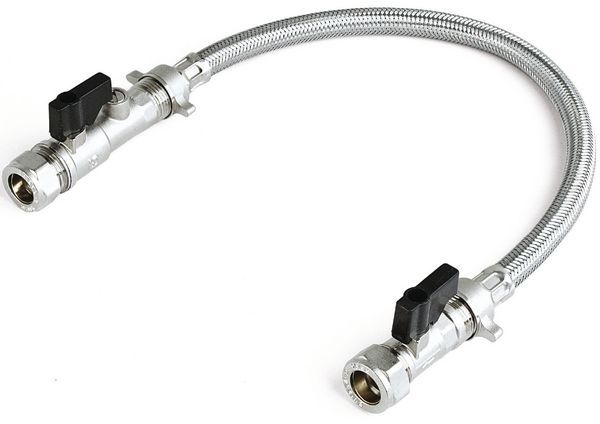
The filling loop is the temporary link from the cold main into the heating circuit: a flexible silver hose with a valve at each end, or two white knobs on an integral loop under a combi. A weep at those connections or valves loses heating water and the gauge falls. If the valves are left open, or a check valve lets by, mains water goes the other way and the gauge rises. Shut both valves firmly after every top-up. A loop that will not hold shut needs replacing. That is an engineer’s job.
Heat exchanger leak
On a combi, a leaking plate heat exchanger can let heating water into the tap circuit (or the other way). Signs include pressure that will not stay put, pressure that moves when a hot tap is opened, or discoloured hot water. A leak on the primary heat exchanger often shows as water in the case or at the PRV. Do not open the case to look. Call a Gas Safe registered engineer.
Safe checks you can do
These checks do not involve opening the gas appliance.
- Read the gauge or digital display with the heating off and cold, then again after the heating has been on. Note both numbers. The cold figure is the one you compare with the manual.
- Walk the radiators and pipework. Look for drips, staining, and damp under valves. Check the airing cupboard and any visible joints under the boiler, without removing the case.
- Go outside and find the PRV discharge pipe. Look for dripping, a wet patch, or lime scale on the end of the pipe.
- If you recently bled radiators, that may be the whole story. Top up once and watch the gauge.
- If the filling loop is visible under the boiler, confirm both valves are fully closed and the hose joints are dry.
How to repressurise a combi through the filling loop
Many combis have the filling loop under the case, where you can reach it without opening the boiler. The exact knobs and the target pressure are in the user instructions for that model. Look the boiler up on boilermanuals.com before you turn anything. If you cannot see the loop, or you are not sure, leave it for a Gas Safe registered engineer.
- Turn the heating off and let the system cool so you are filling to a cold reading.
- Find the filling loop: a flexible hose with a valve at each end, or the integral knobs under the boiler.
- Open both valves slowly. You should hear water entering. Watch the gauge.
- Close both valves when the cold reading is around 1 to 1.5 bar, or the figure in the manual. Do not fill into the red or toward 3 bar. The relief valve will dump the extra.
- Check the loop for drips. Both valves must be fully shut.
- If the boiler is still in lockout, reset it as the instructions describe. Do not keep resetting if the pressure falls again.
Each top-up adds fresh mains water, which dilutes the inhibitor and brings in minerals. Filling is not a repair. Find why the water left.
Vaillant ecoTEC steps and filling-loop photos are on the Vaillant F.22 page. The same 1 to 1.5 bar cold target applies to most other combis, but the knobs differ, so use that boiler’s manual.
Fault codes that mean low pressure
If the display is showing a code, look it up on the fault codes index as well. These are the common low-pressure lockouts on this site:
| Make | Code | What it usually means |
|---|---|---|
| Vaillant | F.22 | Safety switch-off: low water pressure. Top up, then find the leak if it returns. |
| Worcester Bosch | A1 | Pump has run dry or stalled. The first check in the maker’s sequence is system pressure below 1.2 bar. |
| Baxi Duo-tec / Platinum / Megaflo | E119 | System pressure below about 0.5 bar. Restoring pressure often clears it. |
| Baxi 200 & 400 Combi | E.02-.07 / H.02-.06 | Low system water pressure, or a water leak on the boiler or system. |
Newer Worcester Bosch Greenstar displays may show a flashing pressure symbol rather than A1. Treat that the same way: cold pressure first, then the leak. Brand tables: Worcester Bosch, Vaillant, Baxi.
When to call a Gas Safe registered engineer
Topping up from a filling loop you can see, looking for drips, and checking the outdoor relief pipe are reasonable homeowner jobs. Stop there if any of the following apply:
- Anything that needs the boiler case open, including looking at parts inside.
- Recharging or replacing the expansion vessel when it is inside the boiler.
- The pressure drops again after a top-up, or you are filling more than about once a year.
- The PRV pipe outside keeps dripping or running.
- You cannot find the filling loop, or you are not confident using it.
- You suspect a heat exchanger leak, water in the case, or a filling loop that will not shut.
- A fault code returns after you have restored the pressure.
Find a Gas Safe registered engineer through the Gas Safe Register. If you smell gas, use 0800 111 999, not a repair booking.
Frequently asked questions
What pressure should my boiler be at?
Around 1 to 1.5 bar when cold on a typical house or flat, often about 1.2 bar, and a little higher when the heating is on. Check the manufacturer’s manual for your model. More detail is on boiler pressure.
Why does the pressure drop after I bleed the radiators?
You have let air and a little water out of a sealed circuit. Top it back up once. If the gauge then holds, you are done. If it falls again, look for a leak or the PRV pipe outside.
How often should I need to top the boiler up?
Once a year at most is a reasonable sealed-system habit. Filling every few weeks means water is leaving. Fix the cause rather than keep adding mains water, which dilutes the inhibitor.
The pipe outside is dripping. Is that why the pressure drops?
Often. That is the 3 bar pressure-relief discharge. Water leaving there will drop the gauge. An under-charged expansion vessel is a common reason. Call a Gas Safe registered engineer if it keeps dripping. Do not cap the pipe.
Can I recharge the expansion vessel myself?
Not if it means opening the boiler. On most combis and system boilers the vessel is in the case. The air charge is set with the system empty. That is a Gas Safe registered engineer’s job.
The boiler shows F22, A1 or E119. What does that mean?
Low water pressure, or a pump that has run dry because the pressure has already fallen. See the Vaillant F.22, Worcester Bosch A1, and Baxi E119 pages, then restore pressure if the filling loop is accessible. Repeated codes need an engineer.
When should I call a Gas Safe registered engineer?
If the case would have to come off, the expansion vessel needs recharging, the pressure falls again after a top-up, the outdoor relief pipe keeps dripping, or you are not sure how to use the filling loop.
Next steps
- Boiler pressure: the working band, how the gauge should move when the heating is on, and what a rise toward 3 bar means.
- Combi boiler problems: low pressure in the context of other combi faults.
- Boiler repairs: what to check before a call-out, and when it is a gas emergency.
- Fault codes A-Z
- boilermanuals.com: the filling-loop diagram and cold-fill figure for your model.
- Boiler Optimiser: once the heating is running again, a way to pick a sensible heating flow temperature from the radiators you have.
Guidance only. Follow the current manufacturer instructions for the boiler in front of you. Gas work in the UK needs a Gas Safe registered engineer.