

Every new gas boiler sold for central heating in Great Britain has had to be condensing for years. “New combi technology” is not a special 2026 invention. It is a sealed, wall-hung appliance with a plate or combined heat exchanger for taps, a fan-flue, a condensate drain, and electronic modulation. If someone is offering a non-condensing “new” gas combi, walk away.
The point of a combi is still the same: no hot-water cylinder, no feed-and-expansion tank, one cupboard. The cost of that is no immersion backup and no two-bath reserve. Choosing a new combi covers size and brand. This page is what you are buying when the quote says “new combi”.
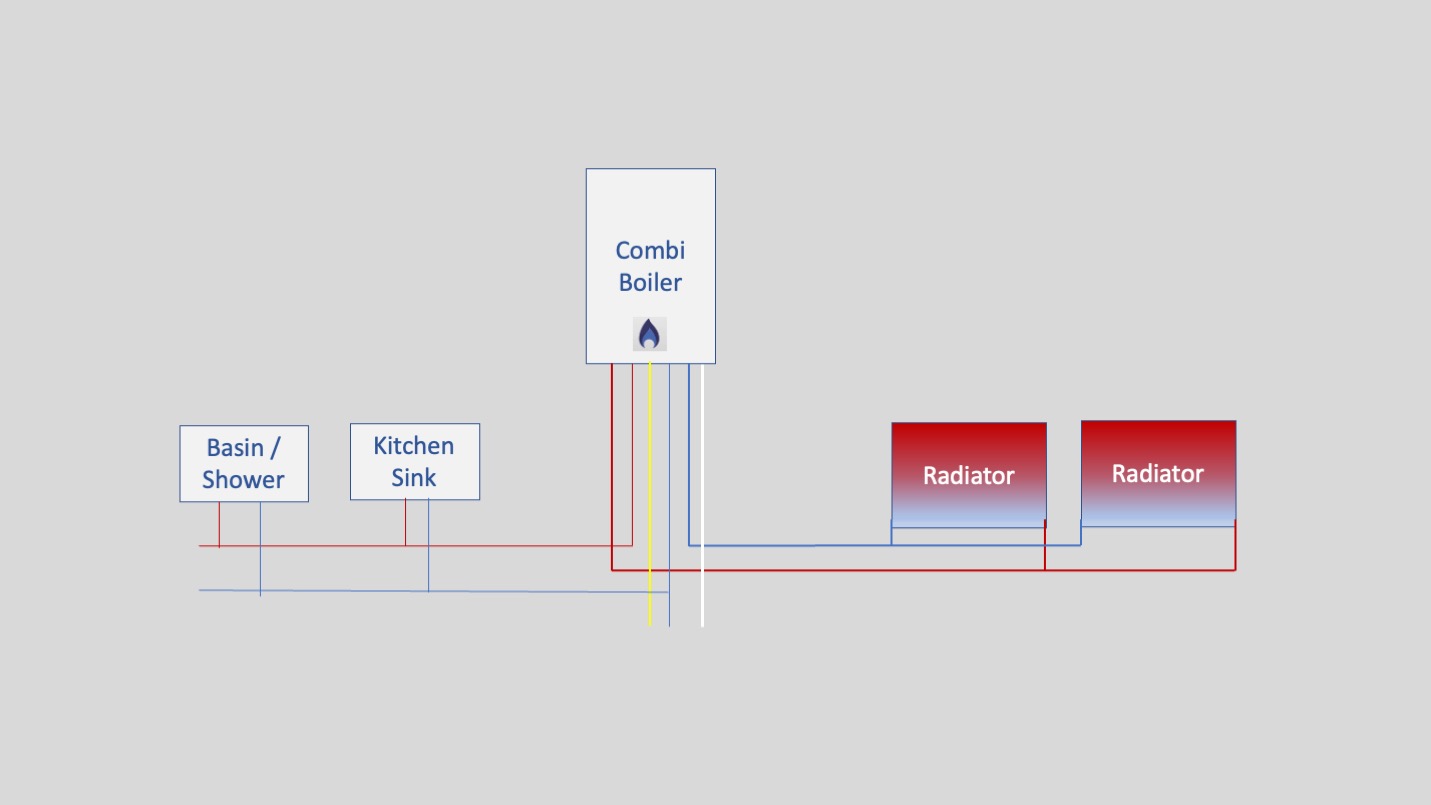
What is actually new on a current combi
- Wider modulation. A modern burner can turn down a long way, so a 30 kW DHW boiler is not dumping 30 kW into a 8 kW heating circuit all afternoon — if the controls let it. That is why OpenTherm or the maker’s own modulating bus matters.
- Better condensing, if you run it cool. The saving is from a low flow temperature and a clean system, not from the word “eco” on the badge. ErP A-rated gas boilers sit in a tight band; the install decides the bill.
- Smaller cases. True for many 24–30 kW models. A 37 kW storage-combi or a high-output box is still a large appliance. Measure the cupboard before you fall for “sleeker”.
- Keep-hot / preheat. Some models hold a little heat in the exchanger so the tap runs hot sooner. That is comfort, and a standing gas use. It is not free.
Hot water the honest way
A combi does not raise mains pressure. If the kitchen cold tap is weak, the hot tap will be weak. The hub’s “flow rate boosters for low pressure” is the wrong picture. A few storage combis hold a few litres so the first draw feels stronger; they still need incoming flow to refill. Two showers at once is a cylinder job, or a very strong main plus a large combi — see low mains water pressure.
Scale in hard water eats plate exchangers. A filter on the heating side and scale control on the incoming cold are part of a long-life install, not extras for the brochure.
Controls are usually a separate product
Plenty of new boilers can join Wi-Fi through the maker’s gateway or a third-party stat. That is not “the boiler is a smart home”. You still choose a room control: maker weather compensation, smart thermostat, or a simple clock. Remote apps save energy only if they stop the boiler running an empty house. They do not replace a Gas Safe service.
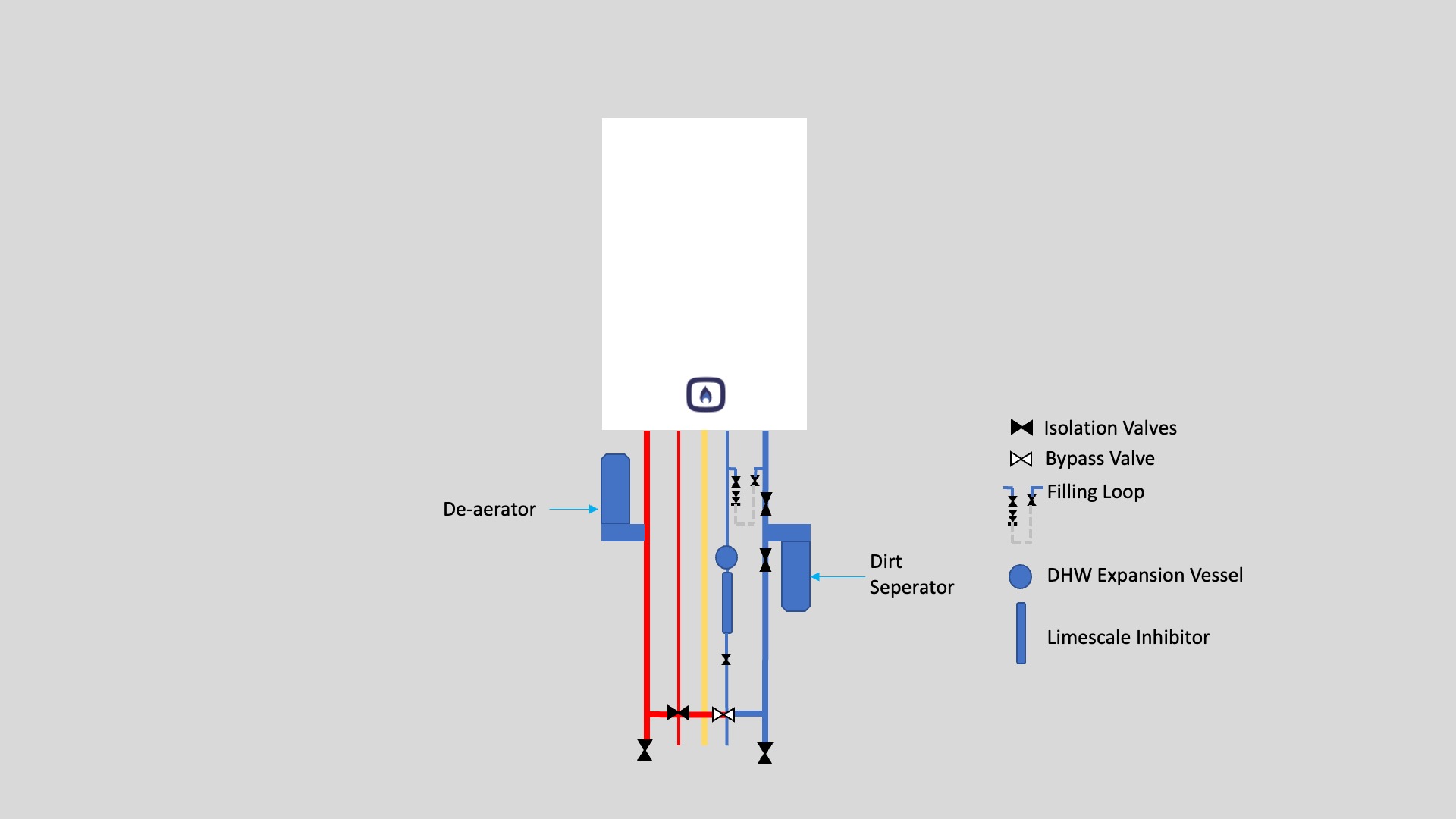
What we put on the wall with a new combi
The parent combi boiler page shows the layout. In short:
- Modulating controls — maker bus, or OpenTherm where the boiler truly has it
- Magnetic or equivalent heating filter (Fernox TF1 / Spirotech class)
- De-aerator on the flow
- A small DHW shock arrestor where the taps hammer
- Scale prevention on the mains in hard-water areas
- A flush, inhibitor to BS 7593, and Benchmark / Building Regulations notification
Environment claims, kept in proportion
A new condensing combi burns less gas than a 1990s non-condensing box if you run it properly. It still burns gas. It is not a renewable. “Hydrogen-ready” on a current UK combi means the maker has a conversion path if a hydrogen grid ever arrives; it is not a reason to buy, and it is not a heat pump. If the house is a candidate for an air source heat pump, say that at survey instead of dressing a gas swap as a climate project. Solar thermal can preheat a cylinder — it does not bolt onto a standard combi in a useful way without a store (see solar thermal and the Intasol exception).
Installation is Gas Safe work: gas, flue, condensate, and the Benchmark pack. A website does not commission a boiler. If you can smell gas, leave and call 0800 111 999.
Related
- Choosing a new combi boiler
- Combi boiler cost
- Combi boiler — layout and life-extending extras
- Combi boiler problems
- What size boiler
- Quote
Guidance only. Gas work in the UK needs a Gas Safe registered engineer. A new combi is not a substitute for a heat-loss calculation or a measured mains flow.