

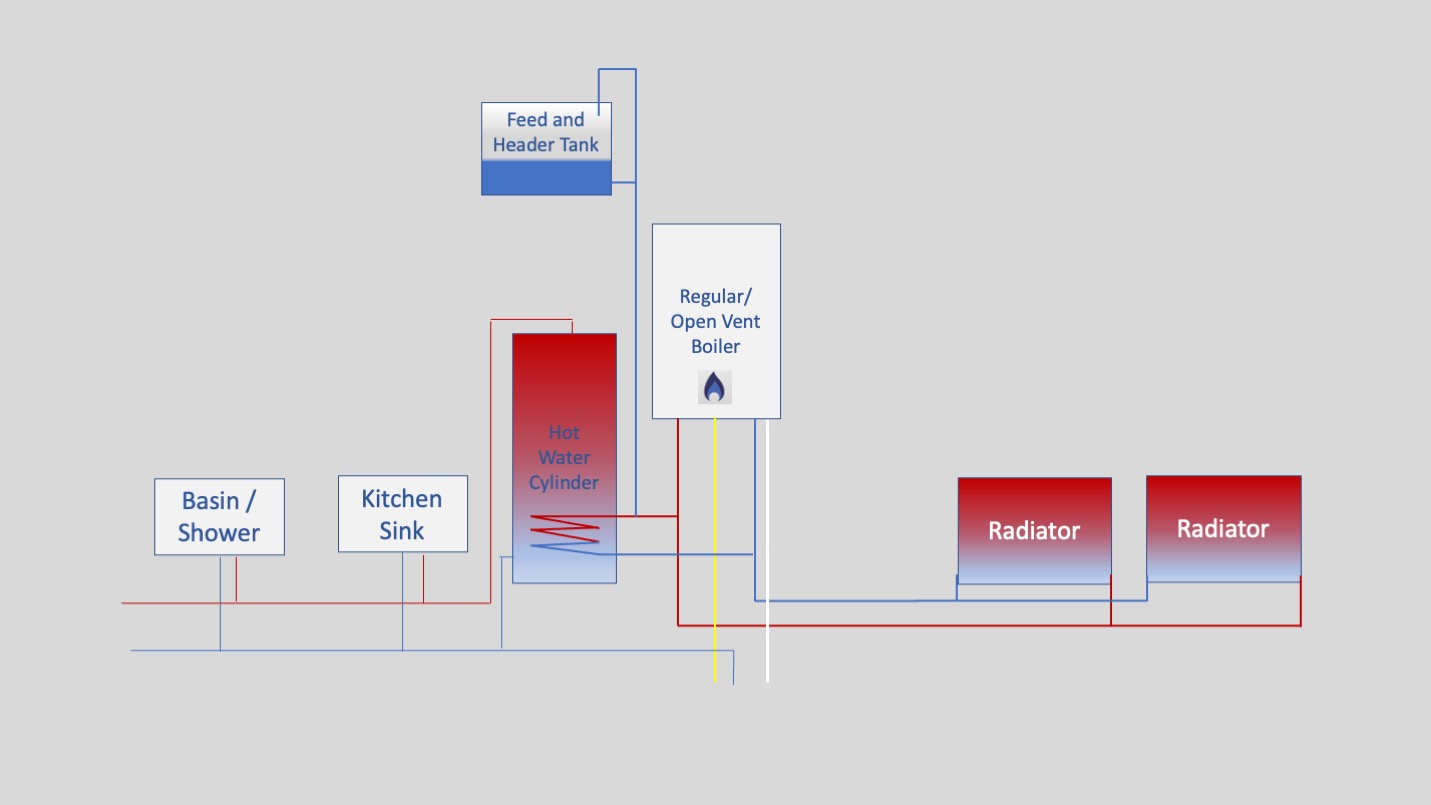
A regular boiler is a heat-only boiler. Inside the case you typically have what is needed to make and control heat: heat exchanger, gas valve, fan, primary flow and return, and the electronics. There is no plate heat exchanger for taps, and there is usually no integral pump or expansion vessel — those are what make a system boiler a system boiler.
Hot water still comes from a cylinder. The boiler heats the cylinder coil; it does not heat the taps itself. That is the same store idea as a system boiler. The difference is how the heating circuit is filled and pressurised, and which parts live in the boiler case.
What has to sit outside the case
The hub draft listed the extras correctly. A regular boiler needs:
- either a loft feed-and-expansion (F&E) cistern (open-vented heating), or a sealed-system kit — expansion vessel and filling loop — if you convert the heating to sealed
- an external circulating pump
- zone valves and controls (and a cylinder, if you want stored hot water)
Older UK installs usually also have a loft cold-water storage cistern feeding the cylinder. Heating then uses the F&E tank; hot water at the taps is gravity from the store, not mains pressure. See boiler types for the side-by-side with combi and system.
Open-vent versus a sealed kit
Open-vent is the traditional regular layout: an open F&E cistern in the loft, a vent pipe, and a heating circuit that is not pressurised like a modern sealed system. That is why a like-for-like regular swap can keep classic pipework and loft tanks. The trade-off, which the boiler-types page already notes, is that open-vent systems are more liable to corrosion than a well-inhibited sealed circuit.
A heat-only boiler can instead be run as a sealed heating circuit with a sealed expansion-vessel kit and a filling loop. The appliance is still a regular (heat-only) boiler — you have not turned it into a system boiler. You have moved expansion and filling onto the pipework. A system boiler puts the pump and a vessel in the case; you may still need a larger extra vessel on a big system.
Header tanks need to sit above the highest radiator or tap they serve. That is why a regular / heat-only layout is a poor fit for most flats. If the cold main is weak and you cannot upgrade it, open-vent storage (or a system boiler with a vented cylinder) is often the workable path. Combis and unvented cylinders both need mains pressure and flow — see low mains water pressure.
Heating controls
Regular boiler systems commonly run an S Plan or S Plan Plus, or a Y Plan. The zone valves and the pump are on the pipework, not in the boiler. Changing to a combi is not a like-for-like boiler swap: the cylinder, tanks and valves come off, and the controls change with them.
Depending on the boiler and the controls, you can also run priority domestic hot water (PDHW): the cylinder call takes a high flow; heating then returns at a lower, weather-compensated or fixed temperature. Not every heat-only boiler has the terminals for that — confirm the handbook before you promise dual setpoints.
Flow temperature on a regular or system boiler is a different job from a combi, because the cylinder still needs a hot coil. See adjusting flow temperature on a system or regular boiler.
When a regular boiler is the honest answer
- Like-for-like replacement of an existing open-vent system, keeping loft tanks and a vented cylinder.
- Weak mains that will not feed a combi or an unvented cylinder, and you cannot upgrade the private supply.
- Space at the boiler is tight: the heat-only case is the smallest of the three types; the tanks and cylinder still need room elsewhere.
- High simultaneous hot water from a correctly sized cylinder — same store logic as a system boiler, not a bigger combi badge.
If you have cupboard space for a cylinder but can drop the loft tanks, a system boiler is usually the cleaner modern sealed layout. Type choice in a real house is on choosing a new boiler.
Related
- What is a combi boiler?
- System boiler
- Boiler types
- Choosing a new boiler
- S Plan and S Plan Plus
- Priority domestic hot water
- System / regular boiler flow temperature
- Low mains water pressure
Guidance only. Gas work in the UK stays with a Gas Safe registered engineer. Open-vent to sealed conversions and cylinder work need a design, not a like-for-like assumption.