

On heating controls you meet these as a boiler or programmer relay, a room-stat changeover, or the end-switch on a motorised 2-port. The coil is drawn separately from the contacts. Normally means the contact position with the coil de-energised.
Contact arrangements
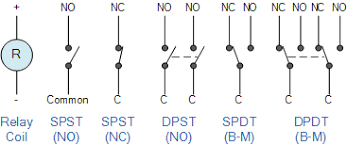
- SPST (NO) — single pole, single throw, normally open. One circuit; closed only when the coil is energised.
- SPST (NC) — single pole, single throw, normally closed. One circuit; opens when the coil is energised.
- DPST (NO) — double pole, single throw, normally open. Two separate circuits switch together.
- SPDT (B-M) — single pole, double throw, break-before-make. One common (C) leaves NC before it makes NO. This is a changeover contact.
- DPDT (B-M) — double pole, double throw, break-before-make. Two changeovers ganged together.
The hub listed every type as “normally closed” and repeated SPST (NO). That does not match the drawing (NO, NC, DPST (NO), SPDT (B-M), DPDT (B-M)).
Normally open versus normally closed in motion
The animation is an SPDT changeover: with the coil off, the pole sits on NC. Energise the coil and it breaks NC, then makes NO.
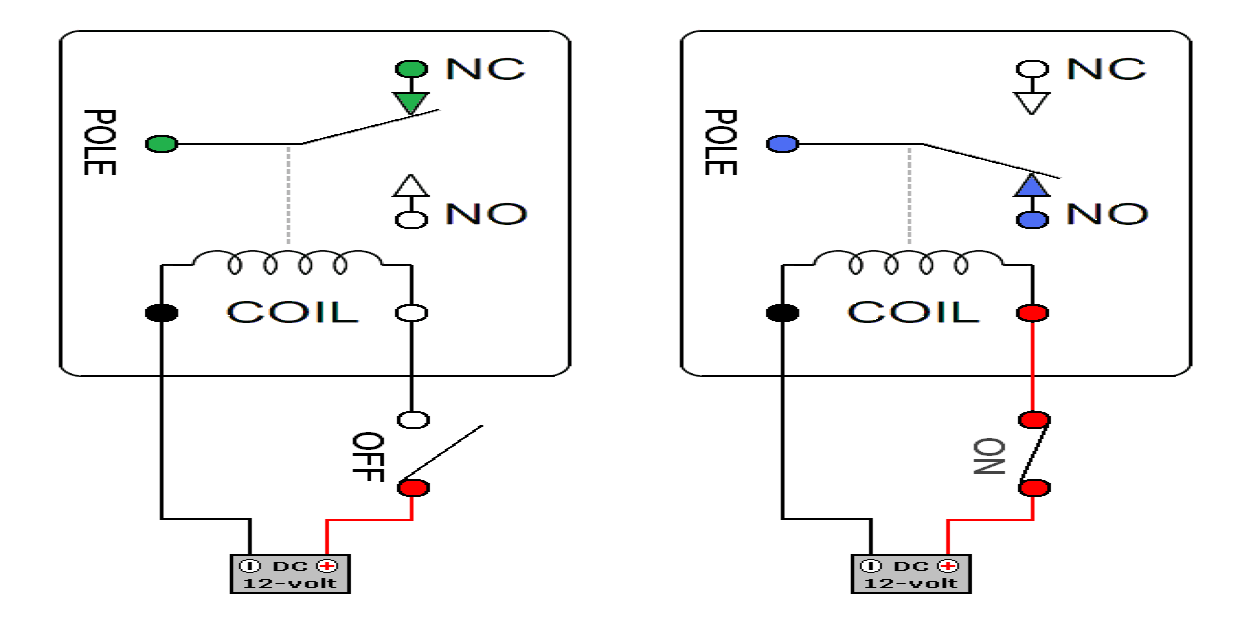
On an S Plan 2-port the grey wire is typically the end-switch that closes when the valve is driven open — that switch behaves like an SPST NO contact, even though the actuator is a motor, not a coil relay. Checkout: 2-port valve checkout.
Related
Guidance only. Isolate the supply before working on controls. Gas work in the UK stays with a Gas Safe registered engineer.