

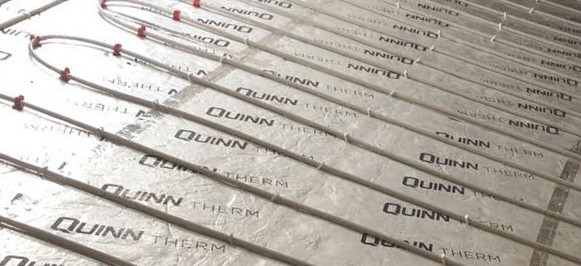
In this article, underfloor heating (UFH) means a wet hydronic system: warm water in pipe loops in the floor, not electric mats. Electric UFH is cheaper to fit in a single bathroom, but as whole-house heat it is expensive to run (COP of 1). Hydronic UFH is the usual choice for a main heating system, especially with a condensing boiler or a heat pump.
A common UK layout is UFH on the ground floor and radiators upstairs. That is not only “radiators feel more reliable”. Timber first floors, floor height, cost, and wanting a faster bedroom response all drive it. A well-designed UFH system in a well-insulated house can heat every floor, including bedrooms — but screed UFH is slow to change temperature, so it suits houses that are kept warm rather than heated in short bursts.
Underfloor heating
The floor is the emitter. Because the surface area is large, the water can run cooler than a traditional radiator circuit. Typical hydronic flow is around 35–45 °C (sometimes up to about 55 °C depending on floor construction and covering). BS EN 1264 limits occupied-room floor surface temperature to about 29 °C (often nearer 27 °C under timber; bathrooms can be a little higher). That low flow is why UFH suits condensing boilers and heat pumps.
Pros
- More even room temperature — less hot-at-the-radiator, cold-at-the-window
- Lower flow temperature, so better condensing and better heat-pump COP
- Clear walls — furniture and layout are less constrained
- Plastic pipe (PEX / MLCP) does not rust like a steel panel radiator
- Pipe warranties are often 25–50 years if the system is installed to the manufacturer’s spec
Cons
- Solid-floor / screed installs cost more and add floor height and programme time
- Needs a competent UFH design: loop lengths, spacing, insulation, manifold balancing
- Floor finish matters — tile and stone transfer heat well; thick carpet does not
- Screed systems are slow to heat up and slow to turn down
- A leak is harder to find than a dripping radiator valve
Carpet and underlay together should stay within the covering limit the system was designed for. BEAMA / industry guidance is typically a combined 2.5 tog ceiling; with a heat pump, keep it nearer 1.5 tog so the flow temperature does not have to climb. Felt underlay is a poor choice. Overlay and joist systems exist for retrofit; they disrupt less than a new screed but usually give less output per square metre, so heat-loss calculations still have to be done.
If UFH shares a boiler with radiators, the floor circuit must not see full boiler flow temperature. Use a mixing / blending valve (UFH pack) and its own pump at the manifold. Water treatment still applies: BS 7593 inhibitor and filtration on the whole system, including mixed UFH + radiator layouts. “Less sludge” is only true in the sense that there is less steel to corrode — untreated mixed systems still sludge.
Radiator-based heating
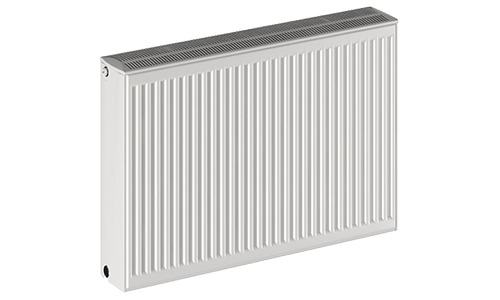
Radiators have been the default UK wet-heating emitter for decades. Panels have improved (K1, K2, K3, low-water-content, and low-temperature designs), and they are available in many sizes and finishes. Traditional boiler circuits often run 70/50 or 75/65. Oversized radiators can run cooler and work with a heat pump, but they still need a heat-loss check — a 75 °C radiator on a 45 °C heat pump will not put out its catalogue figure.
Pros
- Widely available in many sizes, finishes and styles
- Most heating engineers can install and repair them
- Faster to heat a room than a screed floor — better for intermittent occupancy
- Easy room control with TRVs, and easy to isolate or swap a single emitter
- No extra floor build-up; leaks show at the valve or union
Cons
- Steel panels corrode if the system is untreated — sludge, cold spots, noisy pumps
- Heat is more local: warmer at the radiator, cooler across the room
- They take wall space and can dictate furniture layout
- Default high flow temperature is a poor match for a heat pump unless the emitters are enlarged
Which to use
- New, well-insulated ground floor, especially with a heat pump: hydronic UFH is usually the better emitter.
- Bedrooms, timber floors, or houses that heat in short bursts: radiators (or overlay UFH with a proper output check) are often simpler.
- Mixed system: UFH downstairs and radiators up is workable if the UFH is mixed down, both circuits are balanced, and the water is treated.
- One bathroom only: electric UFH is a reasonable extra, not a replacement for the heating system.
Related
- Heat pumps and underfloor heating
- Air conditioning vs radiators
- Heat pumps
- Heating system output calculator
- Radiator correction factor
- TRV pin stuck — how to free it
Important: Information is guidance only. Design UFH to BS EN 1264 and the manufacturer’s instructions. Treat the system to BS 7593. Confirm heat loss before choosing emitters.