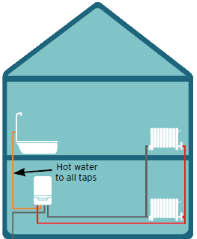
The radiators heating means the boiler can already light. Hot water uses that same boiler, but only after a tap opens and the diverter moves off heating. The usual stop is that the boiler does not see the tap, or the diverter stays on heating.
A Gas Safe registered engineer needs to test those. Do not open the boiler case. More on this is in combi boiler problems.
Hot, then cold, then hot
Water that swings from hot to cold and back is usually limescale in the plate heat exchanger. Hard-water areas see this more often. A Gas Safe registered engineer should do the work.
Hot water means the boiler can light for a tap. Heating needs its own demand from the programmer and the room thermostat, and the diverter back on heating when no tap is running. The heating pipes may also be blocked.
A combi stops if the pressure falls too low. For a typical house, set the gauge to about 1.2 bar when the system is cold. It should stay in the 1 to 2 bar band. If you keep topping it up, water is leaving the system.
Heating needs the programmer and the room thermostat calling. Hot water needs a tap open. If something is calling and you still cannot hear the pump, the sequence stops there. The fan and the burner never get their turn.
The pump is running, so there is a demand. The fan has to run next and prove it is clearing the flue. If you cannot hear the fan, it will not ignite. That check is inside the case.
It clicks, but the flame does not stay on
The fan has run, so the boiler tried to light. A click and no flame, or a flame that drops straight out, is an ignition fault inside the case. A Gas Safe registered engineer needs to see it. Do not open the boiler case.
A combi makes condensate. If that pipe blocks, or freezes outside, the boiler stops. Look at the plastic pipe that leaves the boiler and runs outside. In a cold snap, a warm hot-water bottle on the outside length is the usual first check. Boiling water can split the pipe.
If it freezes again, the pipe needs a better route. Clearing the trap inside the boiler is an engineer’s job. See combi boiler problems.
It kettles or bangs
A kettle noise, sometimes with a light bang, usually means sludge or limescale on the heat exchanger. Clearing that is an engineer’s job. See combi boiler problems.
What has stopped working?
If heating and hot water are both off, check gas and power first. A lit hob does not prove the boiler has gas: the meter valve has to be fully open, because the boiler draws more than a hob. Then check power to the boiler and the programmer.
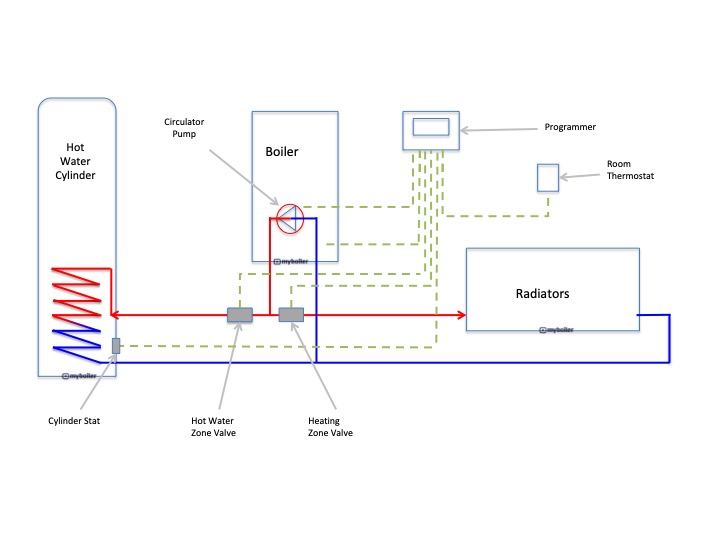
Red is the flow from the boiler. It splits at two zone valves: one opens for the cylinder coil, the other for the radiators. Blue is the return, back through the pump in the boiler. The dashed lines are the controls: the programmer, the room thermostat, and the cylinder stat. A valve that stays shut leaves that circuit cold even when the boiler can fire.
No hot water
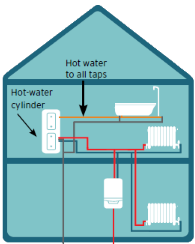
A system boiler heats a separate cylinder. Hot water runs when that channel is on, the cylinder thermostat is calling, and the hot water zone valve has opened. The cylinder thermostat is normally about 60°C, and the boiler flow has to sit above that.
The cylinder is heating, so the boiler can fire. Check the heating channel on the programmer and the room thermostat. On an S Plan the heating zone valve has to open before the radiators warm. See S Plan.
Just one radiator
One radiator cold while the others heat is often a stuck pin in that radiator’s valve. See TRV pin stuck.
A system boiler is sealed. Cold pressure for a typical house is about 1.2 bar, in the 1 to 2 bar band. If you keep topping it up, water is leaving the system. See boiler pressure.
The gauge climbs
Pressure should rise by about 0.5 bar from the cold fill, then fall back as the system cools. A bigger rise, or a climb past 2.5 bar, points at the expansion vessel. That is an engineer’s job. See boiler pressure.
The gauge is normal, but nothing heats
Check gas and power before the controls. A lit hob does not prove the boiler has gas: the meter valve has to be fully open, because the boiler draws more than a hob. Power has to reach the boiler and the programmer.
After that, the programmer has to be on, a thermostat has to be calling, and a zone valve has to open before the boiler is asked to fire. You should then hear the pump, then the fan, and it should stay lit. See S Plan. Do not open the boiler case.
Hot water runs when the programmer’s hot water channel is on, the cylinder thermostat is calling, and the hot water zone valve has opened. The cylinder thermostat is normally about 60°C, and the boiler flow has to sit above that.
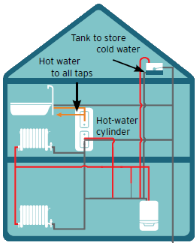
See S Plan. An empty tank in the loft can also starve the cylinder of water.
The cylinder is heating, so the boiler can fire. Check the heating channel and the room thermostat. On an S Plan the heating zone valve has to open. On a regular boiler the pump is often outside the case. See S Plan.
Just one radiator
One radiator cold while the others heat is often a stuck pin in that radiator’s valve. See TRV pin stuck.
An open-vent system usually has no pressure gauge. The tank should hold a level. It should not run dry, and it should not pour out of the overflow while the heating is on. Water pushed up into that tank when the heating runs is a known fault. Tracing it is an engineer’s job. See boiler pressure.
The programmer has to be on, a thermostat has to be calling, and a zone valve has to open. Then you should hear the pump, often outside the case, then the fan, and it should stay lit. See S Plan. Do not open the boiler case.
Cold at the bottom, or noisy
Open-vent systems corrode more than sealed ones. Sludge settles in radiators, so they stay cold along the bottom, and the boiler can kettle. A badly sludged system needs a proper clean. That is an engineer’s job. See boiler types.