

Hybrid Heat Pumps
What is a hybrid heat pump?
Updated September 2026
Hybrid simply means two things combined. A hybrid heat pump system has two heat sources — typically an air source heat pump and a gas boiler. At its most basic it is dual-fuel heating. The heat pump can take most of the year’s space heating; the boiler covers hot water, peak load, or hours when electricity is the dearer kWh. Because a boiler can serve heating, hot water, or both, the two appliances can be split in several ways.
England and Wales: a heat pump fitted alongside a fossil-fuel boiler is not eligible for the Boiler Upgrade Scheme. A standalone air-to-water or ground source heat pump can attract £7,500 (or £9,000 until 31 March 2027 if you replace oil or LPG off the gas grid). MCS design still matters: the controls should be able to prioritise the heat pump, or the boiler can end up doing most of the year’s kWh. Overview and grant detail: Heat pumps. Scheme rules: gov.uk/apply-boiler-upgrade-scheme.
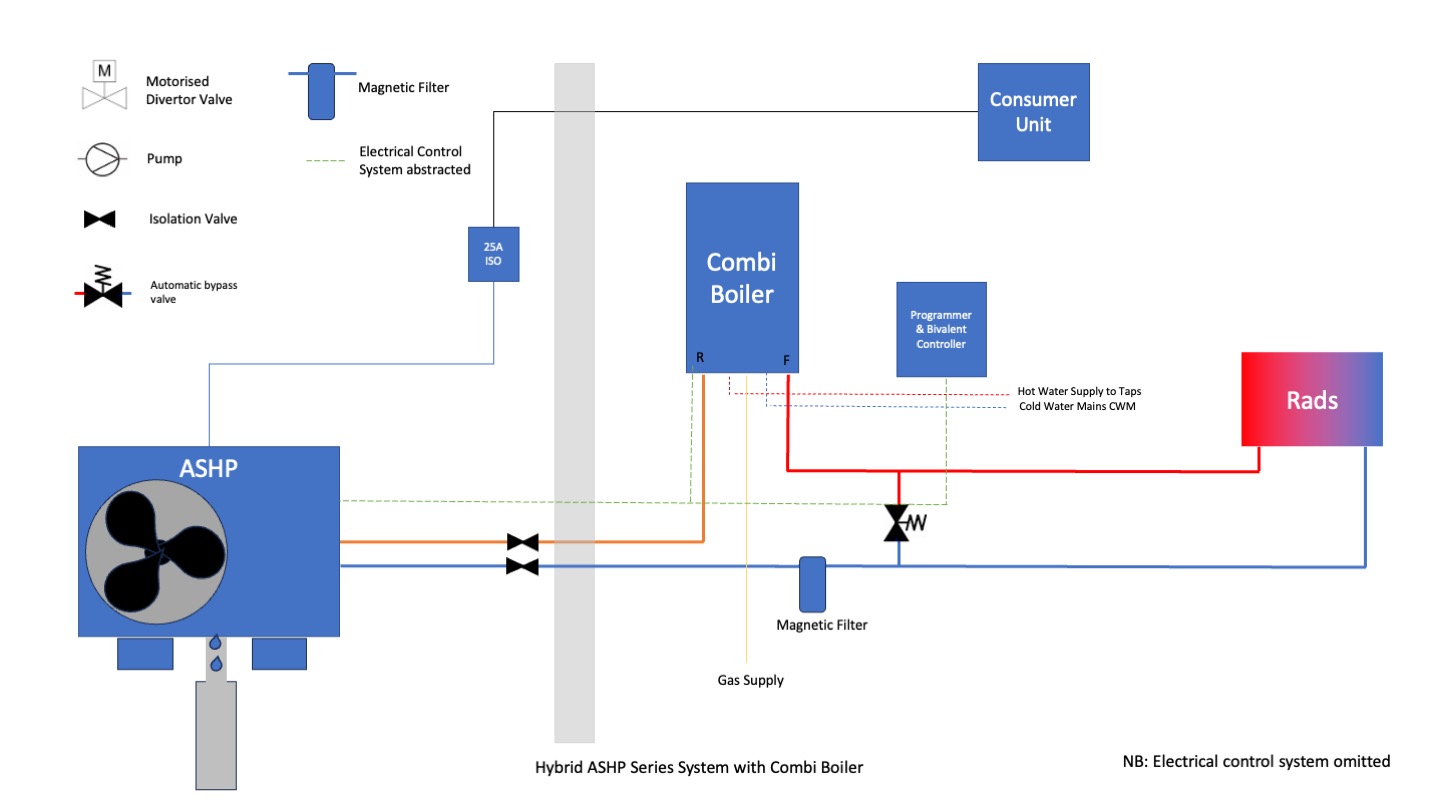
The layout below is common: the combi boiler does heating and hot water; the heat pump does heating only.
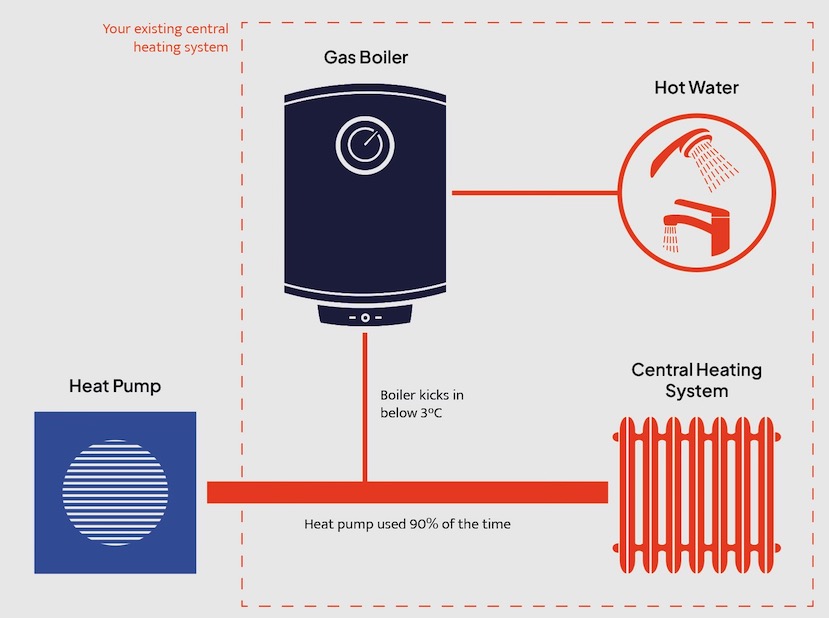
How a hybrid heat pump system works
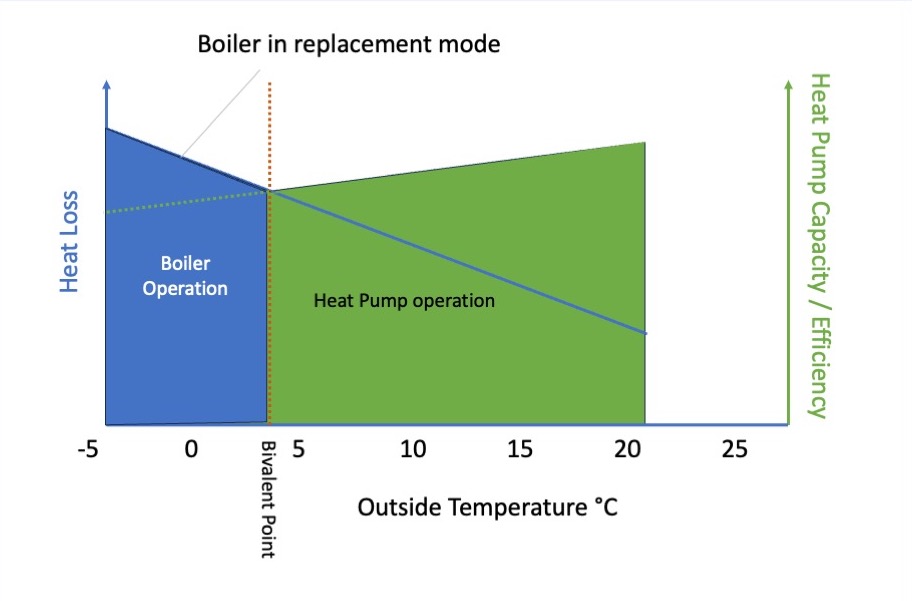
As well as splitting heating and hot water, the two sources can run in different bivalent modes. UK design language is usually changeover, parallel, and series — “bivalent” is the outdoor temperature or load point where the second source is needed.
In bivalent changeover (sometimes called alternative operation), when the outdoor air gets too cold — or the heat pump can no longer meet the load — the system switches over to the backup: boiler, immersion, and so on. The heat pump stops contributing below that point.
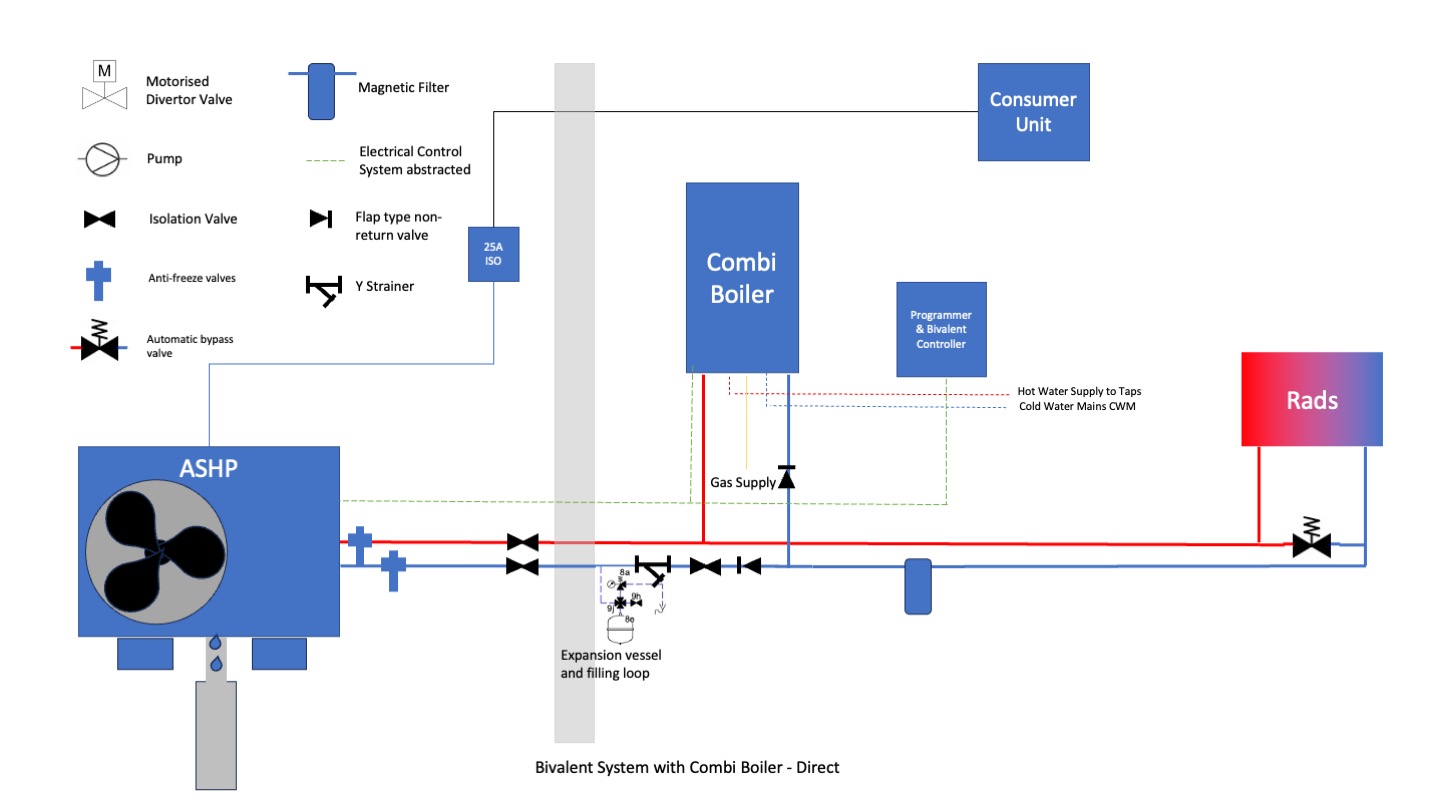
Following is an example schematic. The bypass should only open if there is a restriction, and this layout often has no volumiser because an open heating circuit is used for defrost volume.
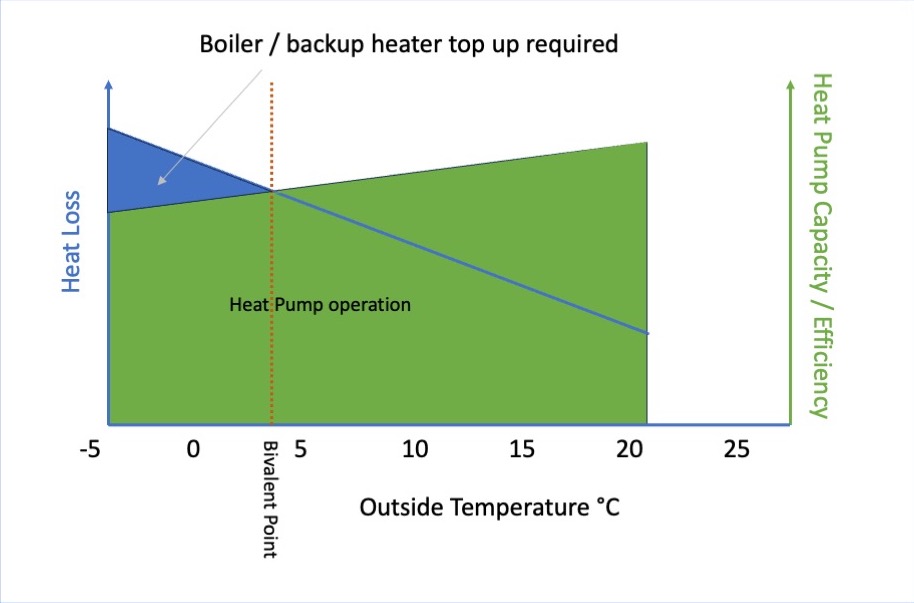
In bivalent parallel operation, the secondary source (boiler or immersion) can run at the same time as the heat pump. As it gets colder it may stay on to assist, or the boiler may take over and the heat pump switch off. Parallel only works as simultaneous heating if the heat pump can deliver the same flow temperature the emitters need; otherwise you get changeover in a parallel pipe layout.
In bivalent series, the heat pump and the backup are in series: the heat pump preheats return water and the boiler lifts it to the required flow temperature. That is usually a packaged set designed to work together. Which source leads can still be decided by outdoor temperature or by which kWh is cheaper (peak / off-peak electricity vs gas).
Why go with a hybrid heat pump?
Economics: the heat pump’s COP can fall below the point where it is cheaper than gas — often on a high flow-temperature system, because COP drops as the lift between outdoor air and flow temperature rises. Instantaneous COP is a snapshot; the bill follows seasonal performance (SPF / SCOP).
Break-even SPF ≈ electricity unit price × boiler efficiency ÷ gas unit price. Using Ofgem GB Direct Debit averages for 1 October–31 December 2026 (26.32p electricity, 7.97p gas; ratio about 3.3): at 90% boiler efficiency you need SPF around 3.0 to match gas on unit rates; at a 92% ErP seasonal figure it is still about 3.0. Real boilers in situ are often closer to 85–90%. A hybrid usually keeps the gas standing charge (about 30p/day on the same cap), so the heat pump has to beat more than the unit-rate test. Prices move every quarter and time-of-use tariffs change the picture.
Power output: the design heat loss is higher than a practical heat pump can cover on its own, so the boiler tops up. Example: 10 kW peak heat loss, but a larger outdoor unit is awkward on noise, space, or permitted development / MCS 020 siting — a smaller single-fan unit such as the Vaillant aroTHERM plus 7 kW can run as the lead, with the gas boiler topping up or taking over in the coldest weather.
Staged journey: you may not want to remove the boiler yet. A hybrid lets you choose how much of the year’s heat the heat pump takes. The mix is set by the installer (bivalent point, flow temperature, emitters) — it is not automatic “greener” if the boiler still does most of the kWh.
Relatively new boiler: similar to the above, scrapping a recent boiler can be a poor carbon and cash decision. An air source heat pump typically lasts 15–20 years with servicing (25 years is a good outcome, not the default). The boiler can come out later if insulation and emitters have been improved enough for a standalone heat pump.
Tariff / cost control (Vaillant calls this triVAI on VRC 700 / sensoCOMFORT hybrids): instead of only switching at a fixed outdoor temperature (for example 3 °C), the control can use entered gas and electricity rates — including peak / off-peak — plus heat-pump COP and boiler efficiency to pick the cheaper source. That is a manufacturer feature, not a generic EN “trivalent mode”, though other hybrid managers do something similar.
Dependence on imported gas: unit rates move. A hybrid can shift the mix toward the heat pump when electricity is cheap (time-of-use, off-peak) and toward the boiler when it is not — if the controls are actually set up that way.
Other reasons:
- redundancy / reliability
- standalone heat pump and associated upgrade costs are too high or not economically feasible
- for staged upgrades ie selecting a heat pump based on best case heat loss once all insulation and emitter improvements are made in the future.
Clarifications: Please note there are various terms such as hybrid, bivalent etc. Some manufacturers or sets of people may have come to associate the work hybrid with a packaged solution in which the heat pump is in series with the boiler. However according to the definition of hybrid, it simply means a thing made by combining two elements or systems.
See also: Heat pumps overview · Air source heat pumps